
How Lighting Design Differs Between Commercial Retail and Industrial Spaces
Lighting serves a purpose far beyond illumination. Across industries, it influences how people experience spaces, perform tasks, interact with their surroundings and operate safely and efficiently. Yet the requirements of effective lighting can differ dramatically from one environment to another.
For lighting professionals, understanding these differences is fundamental to delivering solutions that are not only technically compliant but also appropriate for the people, activities and environments they are designed to serve.
Consider two very different applications: commercial retail and industrial lighting.
Both demand careful consideration of light levels, uniformity, glare, colour rendering, energy efficiency and maintenance. However, the priorities behind these considerations are not necessarily the same.
In retail, lighting is often an integral part of the customer experience and commercial environment. In industrial spaces, it is more closely associated with task visibility, operational performance, safety and reliability.
The distinction highlights an important principle: Good lighting design begins with understanding the application, not simply selecting the luminaire.
Why lighting applications differ across industries
Every built environment has a unique purpose, and lighting must respond to the activities taking place within it.
A hospital requires lighting that supports clinical tasks, patient comfort and different levels of visual sensitivity. Educational environments need lighting that facilitates learning, concentration and visual comfort. Offices must balance productivity, screen-based work and occupant wellbeing.
Similarly, commercial retail and industrial facilities present very different design challenges.
The lighting professional must therefore consider more than the physical dimensions of a space. They must understand who uses it, what tasks are performed, how the environment operates and what outcomes the lighting system needs to achieve.
This is where the distinction between retail and industrial lighting becomes particularly relevant.
Commercial retail lighting: Creating an experience that influences behaviour
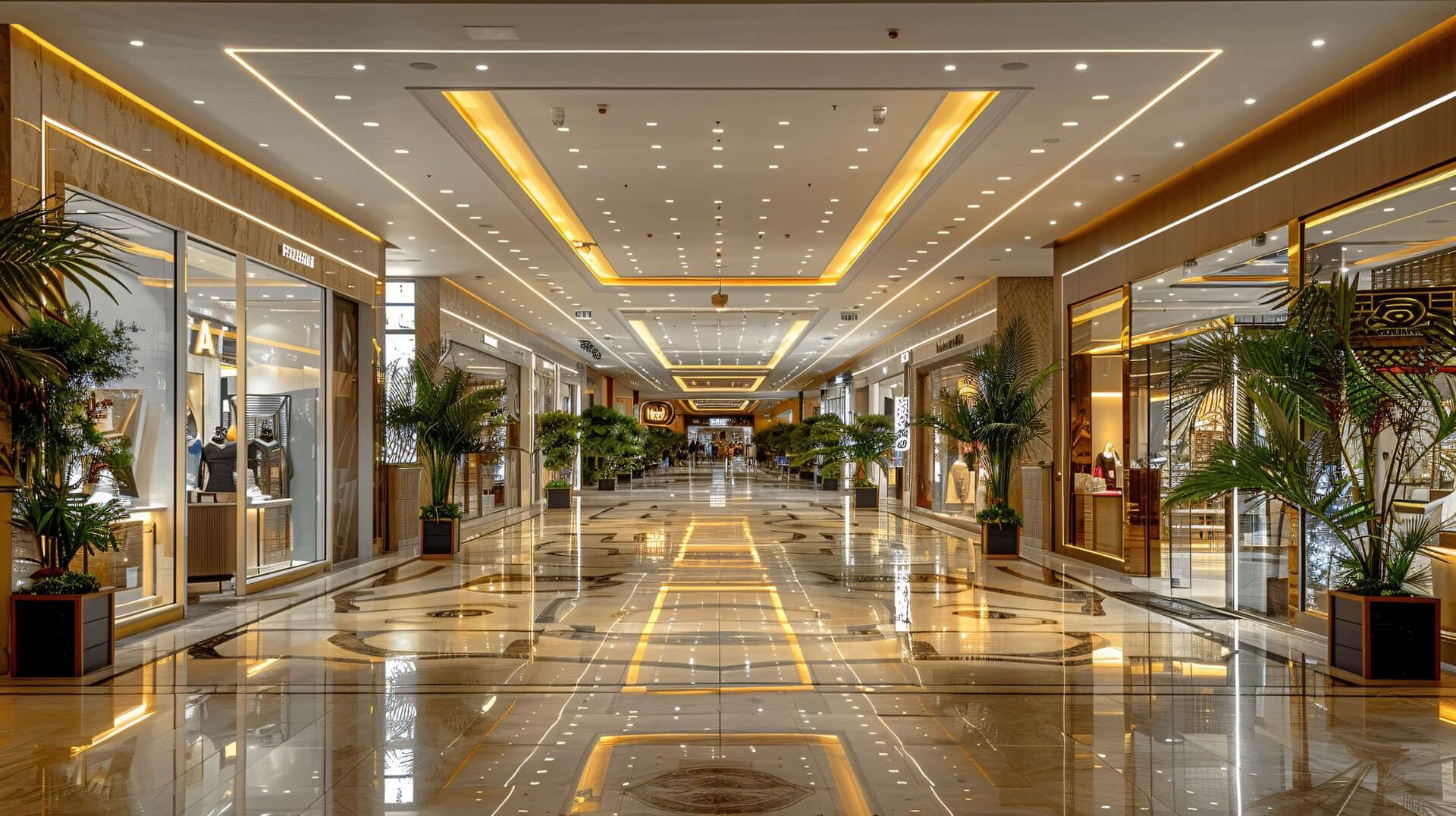
In a retail environment, lighting does more than make products visible. It contributes to the atmosphere, reinforces brand identity, guides customer movement and influences how merchandise is perceived.
Whether designing lighting for a supermarket, fashion boutique, shopping centre or speciality store, the objective is often to create a visually engaging environment that encourages customers to explore and interact with products.
Key considerations in retail lighting include:
1. Visual appeal and product presentation
Lighting plays a significant role in how products are perceived. Colour rendering, colour temperature, beam distribution and contrast can all influence the appearance of merchandise.
For example, lighting in a fashion store may be designed to reveal fabric textures and colours accurately, while lighting in a fresh-food environment may emphasise the natural appearance of produce without misrepresenting its colour.
2. Creating atmosphere and brand identity
Retail lighting contributes to the personality of a space.
A premium boutique may favour carefully controlled accent lighting and a more intimate atmosphere, while a large supermarket typically requires broad, consistent illumination that supports easy navigation and product visibility.
The lighting approach must complement the brand and the intended customer experience.
3. Directing attention and movement
Lighting can create visual hierarchy, highlighting featured products, displays, promotional areas and important customer touchpoints.
By balancing ambient, accent and display lighting, designers can guide attention without relying exclusively on signage or physical barriers.
4. Flexibility and adaptability
Retail environments frequently change their layouts, displays and promotional campaigns.
Lighting systems must increasingly accommodate this flexibility through adjustable luminaires, adaptable track systems, zoning and intelligent controls.
5. Energy efficiency without compromising the experience
Retail spaces often operate for extended hours, making energy consumption a significant consideration.
The challenge is to optimise efficiency while preserving the visual quality and atmosphere that contribute to the commercial environment.
The retail lighting challenge: How do we create an attractive, comfortable and energy-efficient environment that supports both the customer experience and the retailer's commercial objectives?
Industrial lighting: Supporting safety, precision and operational performance
Industrial environments place a different set of demands on lighting systems.
In factories, warehouses, production facilities, workshops and distribution centres, lighting must support employees performing tasks that may require precision, concentration and awareness of potential hazards.
The consequences of inadequate lighting can extend beyond visual discomfort to increased operational risk, reduced task accuracy and potential safety concerns.
Key considerations in industrial lighting include:
1. Task visibility and visual accuracy
Industrial activities vary significantly in their visual demands.
General warehouse operations, detailed assembly work, machinery inspection and quality control do not necessarily require the same lighting conditions.
Lighting professionals must assess task-specific illuminance, contrast, uniformity, glare and colour rendering to ensure workers can perform their duties effectively.
2. Workplace safety
Industrial lighting must support the visibility of machinery, moving equipment, pedestrian routes, obstacles and potential hazards.
Poorly positioned luminaires, excessive glare or deep shadows can compromise visibility in areas where workers need to make quick and accurate visual assessments.
Appropriate emergency lighting and compliance with relevant occupational safety requirements are also essential.
3. Durability and environmental conditions
Unlike many retail environments, industrial spaces may expose luminaires to dust, moisture, vibration, chemicals or extreme temperatures.
Selecting lighting equipment with suitable ingress protection, mechanical robustness, thermal performance and environmental resistance is therefore critical.
The lighting system must be capable of performing reliably under the conditions in which it operates.
4. Uniformity and glare control
Industrial environments often feature high ceilings, large open areas, storage racks and machinery.
Achieving appropriate illumination across work areas while controlling glare and unwanted shadows can be challenging.
High-bay lighting, task lighting and carefully planned luminaire placement may all form part of an effective solution.
5. Energy efficiency, maintenance and operational continuity
Many industrial facilities operate extended shifts or around the clock.
Energy efficiency is therefore important, but so too are reliability, maintenance accessibility and the potential disruption caused by lighting failures.
Intelligent controls, occupancy detection, daylight integration and suitable maintenance strategies can help reduce operating costs without compromising lighting performance.
The industrial lighting challenge: How do we deliver safe, reliable and efficient illumination that supports employees, complex tasks and uninterrupted operations?
Different priorities, shared professional responsibilities
Although retail and industrial lighting serve different objectives, they are grounded in many of the same lighting principles.
| Design consideration | Commercial retail | Industrial spaces |
|---|---|---|
| Primary objective | Customer experience, product presentation and visual appeal | Task performance, safety and operational reliability |
| Visual priorities | Colour quality, contrast, accent lighting and atmosphere | Task visibility, uniformity, glare control and accuracy |
| Lighting flexibility | Changing displays, layouts and promotions | Changing workstations, production processes and operating zones |
| Environmental demands | Aesthetics, comfort and integration with architecture | Durability, environmental protection and maintainability |
| Energy efficiency | Balancing operating costs with visual experience | Managing energy use, maintenance and operational continuity |
| Controls and technology | Scene-setting, dimming and adaptable lighting zones | Occupancy sensing, daylight control and operational integration |
These distinctions are not absolute. A retail stockroom may have lighting needs similar to a warehouse, while an industrial inspection station may demand exceptionally high colour accuracy.
This reinforces why lighting professionals should assess individual spaces and tasks rather than rely solely on broad building classifications.
Why specialised lighting knowledge matters
A technically efficient lighting system is not necessarily an effective one if it fails to meet the requirements of its intended environment.
The right solution requires an understanding of applicable standards, lighting design principles, emerging technologies and the practical realities of each application.
For the lighting profession, this highlights the importance of continuous professional development and specialised technical knowledge.
As lighting applications become more sophisticated, professionals must remain equipped to assess, design and specify solutions that respond to the changing needs of different industries.
For IESSA, the message is clear: Effective lighting design is not about illuminating every space in the same way. It is about applying the right knowledge, principles and technologies to achieve the right outcomes for each environment.
As the profession evolves, application-specific expertise will remain essential to delivering lighting that is fit for purpose, responsible and effective.
IESSA remains committed to advancing lighting knowledge, professional development and best practice across the diverse applications of illumination engineering in South Africa.
IESSA represents South Africa internationally and thereby acts as the National Committee of the CIE (Commission International De L'Eclairage). South African Experts on various topics in the lighting technology field serve on the CIE international committees responsible for the development of standards for the different aspects of illumination.
Membership of IESSA is open to both individuals and organisations active in the lighting industry of South Africa. You need to be a Lighting Professional to join IESSA. Group membership is open to any educational, scientific, technical, professional, institution, public, commercial, municipal, or parastatal entity that is actively involved in the lighting industry.
If you would like to know more about IESSA and the benefits of becoming a member, email us at info@iessa.org.za