
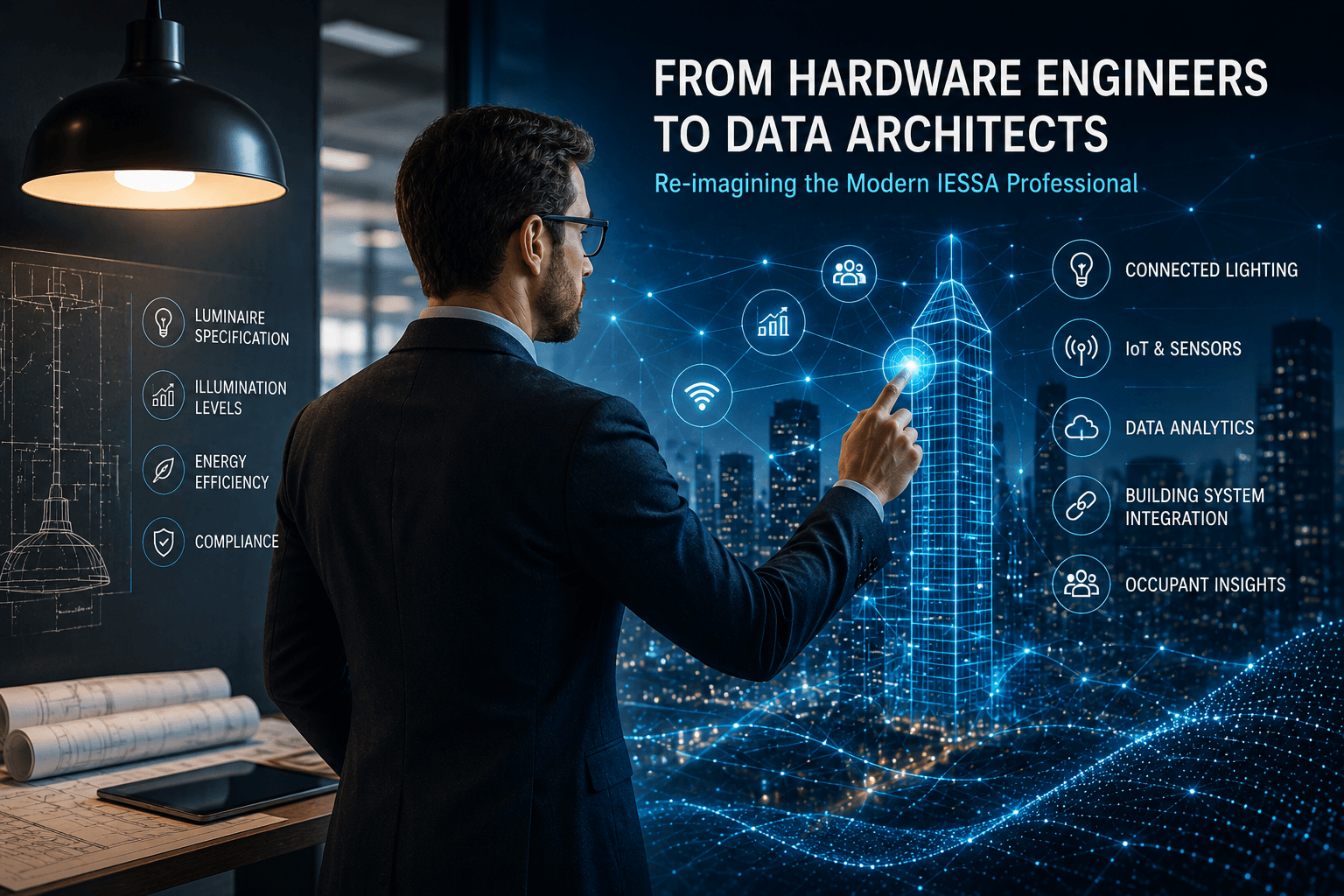
From Hardware Engineers to Data Architects
Re-imagining the Modern IESSA Professional
For decades, the role of the lighting professional was clearly defined: calculate illumination levels, specify compliant luminaires, optimise energy efficiency, and create environments that were safe, functional and visually appealing. While these fundamentals remain as important as ever, the profession is undergoing a remarkable transformation.
Today's lighting systems do far more than illuminate a space. They collect information, communicate with other building systems, respond intelligently to changing conditions and provide valuable insights that influence how buildings are designed, managed and occupied. In many ways, lighting has evolved into one of the most intelligent layers of modern infrastructure.
This shift is being driven by digitalisation, the Internet of Things (IoT), artificial intelligence and increasingly connected building management systems. As a result, the boundaries between electrical engineering, information technology and data science are becoming increasingly blurred.
For South African lighting professionals, this presents an exciting opportunity. Those who embrace these technologies will not simply remain relevant, they will become indispensable partners in shaping the next generation of smart buildings and cities. The modern lighting professional is evolving from a hardware specifier into a spatial data architect.
From Products to Intelligent Platforms
Traditionally, much of a lighting professional's expertise centred on selecting the right luminaire for the right application. Performance, efficiency, maintenance and compliance were key considerations.
While these remain essential, specifying a luminaire alone is no longer where the greatest value lies.
Today's lighting infrastructure functions as an interconnected digital platform. Technologies such as DALI-2 (including memory banks 251,252 and 253), Power over Ethernet (PoE), wireless mesh networks and integrated building management systems allow every luminaire to become an intelligent endpoint within a wider communications network.
Instead of operating independently, lighting systems now communicate with HVAC systems, security platforms, occupancy controls, energy management software and cloud-based analytics platforms.
Perhaps even more valuable is the data these systems generate.
Modern luminaires frequently incorporate occupancy sensors, daylight sensors, environmental monitoring and energy metering. Together, they create a continuous stream of information that provides insights into how spaces are actually used.
Questions that were once impossible to answer can now be measured in real time:
- Which meeting rooms are underutilised?
- How does occupancy fluctuate throughout the day?
- Where can energy consumption be reduced?
- Which spaces require redesign to improve productivity?
- How can maintenance become predictive rather than reactive?
Lighting has effectively become the digital nervous system of the building.
Rather than simply illuminating an environment, today's lighting systems help organisations understand how that environment functions.
Creating Greater Value Through Data
This evolution dramatically elevates the role of the lighting professional.
Historically, lighting consultants were often introduced relatively late in the project lifecycle after many strategic decisions had already been made. Increasingly, however, developers, architects and consulting engineers recognise that intelligent lighting infrastructure forms a foundational component of any smart building strategy.
Lighting professionals who understand both illumination and data integration now earn a seat at the earliest planning discussions.
Their expertise extends beyond lighting layouts to influencing:
- Smart building strategies
- Digital infrastructure planning
- Occupant wellbeing
- Sustainability initiatives
- Energy optimisation
- Operational efficiency
- Space utilisation
This broader contribution also creates measurable commercial value for facility managers, enabling buildings to operate more energy efficiently while supporting compliance with requirements and targets such as Energy Performance Certificates (EPCs) and Net Zero Carbon (NZC).
Clients are no longer investing solely in lighting systems; they are investing in business intelligence.
When lighting professionals can demonstrate how sensor-generated data reduces operational costs, improves workplace utilisation, supports ESG reporting or enhances occupant comfort, conversations shift away from equipment pricing towards measurable return on investment.
The profession moves from being viewed as a project cost to becoming a strategic business partner.
For consulting engineers and lighting designers, this presents an opportunity to justify higher-value advisory services that extend well beyond traditional design fees.
Building the Skills for Tomorrow
Naturally, this transition introduces new challenges.
Many experienced professionals may feel uncertain when discussions turn towards IP networks, APIs, cloud platforms, cybersecurity or system interoperability. These topics have historically fallen outside the scope of conventional lighting education.
The encouraging reality is that lighting professionals do not need to become software developers.
Instead, they need to develop a practical understanding of how intelligent lighting systems connect within the broader digital ecosystem.
Key competencies for the future include:
- Understanding basic networking principles
- Working knowledge of protocols such as DALI-2 and wireless communication standards
- Building practical competency in lighting controls, commissioning and system maintenance, particularly in a market where basic controls knowledge remains limited and BMS functionality is sometimes disabled or underutilised due to skills and maintenance gaps
- Appreciating API integrations between lighting and other building systems
- Understanding cloud-based analytics platforms
- Interpreting occupancy and environmental data
- Ensuring interoperability between multiple manufacturers and technologies
Equally important is understanding how international standards and best practices support these connected environments while maintaining reliability, cybersecurity and future scalability.
This is where organisations such as IESSA play an increasingly vital role.
Through continued professional development, technical education, industry collaboration and peer-to-peer knowledge sharing, lighting professionals can confidently bridge the gap between electrical engineering and digital technologies.
The future will belong to professionals who commit to lifelong learning.
Leading the Connected Future
The lighting industry has always evolved alongside advances in technology.
From incandescent lamps to LEDs, from manual switching to intelligent controls, every generation has adapted to change. Today's digital transformation represents another significant milestone, but one with far greater implications than previous technological shifts.
Lighting professionals are no longer simply designing illumination.
They are designing connected environments that improve operational efficiency, enhance occupant wellbeing, optimise energy use and generate valuable business intelligence.
For South Africa, where smarter infrastructure, improved resource efficiency and sustainable development remain national priorities, this evolution presents an opportunity for the lighting profession to play an even greater leadership role.
The future belongs to professionals who can seamlessly combine the science of illumination with the intelligence of connectivity.
As the industry continues to evolve, IESSA members have the opportunity to lead this transformation, not simply by adopting new technologies, but by helping shape how intelligent buildings and cities of the future are designed, connected and experienced.
Because tomorrow's most valuable lighting professional won't simply ask, "How bright should this space be?"
They'll ask, "What can this space tell us?"
IESSA represents South Africa internationally and thereby acts as the National Committee of the CIE (Commission International De L'Eclairage). South African Experts on various topics in the lighting technology field serve on the CIE international committees responsible for the development of standards for the different aspects of illumination.
Membership of IESSA is open to both individuals and organisations active in the lighting industry of South Africa. You need to be a Lighting Professional to join IESSA. Group membership is open to any educational, scientific, technical, professional, institution, public, commercial, municipal, or parastatal entity that is actively involved in the lighting industry.
If you would like to know more about IESSA and the benefits of becoming a member, email us at info@iessa.org.za